[caption id=“attachment_1018” align=“alignleft” width=“200”] Ann Gates Fiser[/caption]
We at Songwriters in Seattle are sad to hear of the passing of our friend, creative colleague, and community partner, Ann Gates Fiser. Ann joined SiS in 2013 - her warm heart and enthusiasm for music and community was infectious. She was a dedicated member of our Board of Directors for many years, often calling into our monthly meeting even when she was too sick to take part in person. Building community was important to her, and if you ever attended one of her events at The Den, where she hosted both a showcase and open mic each month, you know how much she loved being a part of it.
Ann was a creative force, not only as a musician, but also as a visual artist, running an art studio in Kirkland with her husband, Rob. She wrote music, recorded, performed, painted murals, illustrated children’s books, and more. Her SiS Board of directors byline read:
Ann is a singer-songwriter who plays the guitar and keyboards. She cut her musical teeth playing in Austin, Dallas/Ft Worth, and Vail, CO bars, hotels, and restaurants playing pop, top 40, country, and show tunes, and always in the background writing and singing her own songs. Finally burning out with the bar scene she quit music altogether and started a whole new career as a mural artist. She could not stay away from music for long and returned in 2013 with a commitment to play the music she loves which includes, of course, her own original songs. Her lyric topics are wide ranging and her music genre is somewhat eclectic. Learn more about Ann at anngatesfisermusic.com and fiserartstudio.com.
Ann will be missed by all in Songwriters in Seattle and our northwest creative community at large. In many ways she embodied the ideal intersection of welcoming community and creative spirit - we are honored and thankful to have been a part of her journey.
“Do one thing each day that scares you” - Eleanor Roosevelt
For Pacific Northwest songwriter Laura Berman, this quote embodies her approach to her music and her life. While she acknowledges that there are scary things that should be avoided, many of our scary things are self-created. “Your instincts are smart and generally on-point, so listen. But sending an email about booking, or writing a bridge, or reaching out to a friend who is hurting? When you drop into it, those are not the things that are doing the ‘scaring’ - there is something underneath. Once you get okay with that scary underneath part, you live your life in a deeper sense of freedom.”
Her own journey into that freedom arose from the structure of piano and violin lessons in elementary school and orchestra, choir, music summer camps, county and state choirs, and voice lessons throughout junior and senior high school. Berman recalled, “Music always made me feel good. From an early age, I knew it must be a part of my life. Whether it was joining choir in junior high school, joining bands, or writing songs and playing out, I just put one foot in front of the other and did the next right thing that felt good to me.”
Berman began to approach songwriting with greater intent after a move to the “Big Apple”. She remembered, “I had written songs here and there but didn’t start songwriting more seriously until I lived in NYC in my twenties; I was doing quite a bit of singing in cover bands and being introduced to lots of different songwriting styles, musically and lyrically.”
Inspired by the exposure to a wide variety of styles, Berman began to follow her own muse. “One day, I sat down at my keyboard and started writing, and it just became part of who I was. I bought a cheapie acoustic guitar later on and started writing just by ear on guitar, too. I played lots of gigs in NYC and at the beginning was still very green, but I just threw myself in. It was scary, but exciting!” She faced her fears and found, “The best approach for me has been to think less, and do more.”
Berman again followed the advice of Eleanor Roosevelt and dove into her creative “scary things” as she continued her career. Berman shared, “I’d been afraid to perform on acoustic guitar because I’m a pianist. But I started bringing my guitar with me to gigs and sharing a song or two. What was the worst thing that could happen? Why would I care what anyone thinks? Sure, I played wrong notes and, sure, I didn’t have the facility on guitar yet, and yes, it was scary to be that vulnerable, but I was compelled to not let my monkey-mind negative thinking prevent me from growing.”
Opportunities to perform and grow abounded during her time living in New York City. “There were fewer Indie singer/songwriters and artists than there are out there today, so there was definitely less competition for those slots at the clubs. Gigs were pretty easy to book. Back then, there wasn’t social networking, Facebook, etc., so promotion was basically making phone calls and handing out postcards - old school! But it was always a thrill to see your name and gig listed in the Village Voice.”
As she has continued on her songwriting journey, Berman’s process is as diverse as her life experiences. “I generally have a melodic hook singing itself over and over in my mind, and then I pick up the guitar, or sit at the keyboard, and find the best chords to fit with that melodic hook. Sometimes I’ll adjust the melody if there’s a better chord choice… I can sing the whole song with a hum, or a ‘la la’. It’s fun to sing! No one would have an idea what I’m talking about because it’s just gibberish instead of lyrics. The lyrical ideas take a while because lyrics don’t always come so easily to me that way.”
However, her lyrical approach does have times when inspiration strikes and the process becomes more fluid. “Sometimes, if I have an interesting song title that pops into my head, I’ll go ahead and create a Word doc with that title and lyrics come out pretty easily. Something about being at the computer, in an ‘office’ type setting uses a different part of my brain. The writer in me loves that approach. I go ahead and print it out and it signifies to me a new songwriting start. I’ll edit the lyrics when I’m finding chords and melodies, but it feels so good to have a printout as a starting point.”
For songwriters who are starting out, Berman offers up her advice for how to become a better writer. “Listen to really well written songs! And songs that are in different genres of music, even genres you don’t gravitate towards. Listen to the Top 20 Countdowns in Pop, Folk, Country, R&B. Read stories of how good songwriters came to become really good songwriters. And be open to having those who are better than you listen to your songs and critique them. Surround yourself with those at your level or higher - that’s how we grow!”
Not just one to give advice, Berman shared how she made use of experts to help improve her writing. “The representatives at BMI were always really open to meeting with me when I’d travel to Nashville. I got some really great feedback on some of my songs when I was there and was grateful for the time they took to sit down with me. Also, whenever I find an artist I like, I listen to their music online (and buy it, important!).”
But improving as a writer is only part of the equation. Berman additionally seeks to widen her community of musical inspirations. When she encounters a new favorite artist, “I always like to read their bio, and if they have a blog, I read that too. I also like to see who they write and perform with and how they all influence and inspire each other. All of this has helped me to not feel so alone - we are all in it together.” She adds her own advice hoping to inspire other writers, “Don’t stay too attached to your songs, or what others think: write it, listen to it, let it make you smile - then let it go. You’ve got more in you to write!”
In reflecting on her own journey stepping through her fears, Berman offers additional advice for aspiring singer-songwriters. “Do that one thing you’ve waited on, one thing you’ve been delaying, something as seemingly small as writing just one line in Verse 2, or sending an email to thank someone, or sending a check to an organization that inspires you. As we practice doing this one scary thing, the fears of doing it wrong, or not seeing where it’s leading, etc. sort of lose the charge, the energy of fear.”
Berman does not consider herself a ‘prolific writer’. She explained, “It takes me a long time to finish my songs, and when I’m in the thick of finishing my songs, I forget that it’s my process and that is okay. Each artist has his/her own process and timeline.”
A part of life that impacts her process is stress. “The stress of having to make your living as a full-time musician can often have a negative effect on your mental wellness, and especially your creativity. Stress of any kind, at least for me, can stifle my creativity. It’s all about balance - creating a balanced life system that supports you. What works for another may or may not work for you. Life has to feel good!”
Her own sense of balance as a working musician has developed over time. “I’ve gone through stages of my life where I’ve been doing music full-time, touring, etc., and it’s really hard on me, being away from home for so long, and it can be taxing on my body… so I’ve created a balance for myself where I pick up side projects here and there inbetween music-making, things that have nothing to do with music. This helps clear my mind, and I can make some consistent money for a while.”
This approach allows for Berman to take the time to let the process of living life become an inspiration. “I’m inspired by people and good things happening in the world. As I’ve gotten older, it happens less and less where I think I’m supposed to be ‘doing’ music and songwriting - I’m more focused now on doing/being happy, healthy, and balanced, and not letting any one thing define me. It’s not the thing you do, it’s who you are being! Creating opportunities to stretch and grow is what brings me to life.”
As she begins recording her new record in January of 2018, Berman reflected, “It often feels daunting to know what you want to do, what you want to pursue, how you want to live and be in the world, but not know which direction to take, where to plant your first step. And the energy underneath all of that is often fear of not succeeding, fear of making a mistake or a misstep, or turning down the wrong road.”
Pushing aside all the worldly expectations and fears of writers, Berman shared about her new album, “I’m really excited about this one - writing these new songs for me, with no expectations for any further success or visibility - just for me. It feels so good.”
In the final analysis, Berman shared that becoming self-aware is an important key to personal discovery as a writer. She challenges writers to, “Be aware of why you do or don’t do the things you do. Is it a scary thing that is covering up some old patterns? Does it feel scary because you’re stretching and growing? Does it feel scary because it’s frightening and not something you’ll ever do?” But she added as an encouraging note, “Whatever and however, enjoy the process. One day you wake up and you realize it’s you that’s standing in your way. And you will breathe in deeply and feel relieved because you are free.”
Berman is standing in her own freedom now, arms open wide and, if there are scary things ahead, she is unafraid to face them head on and continue the journey.
TV commercial jingles… 60-70’s rock… folk… heavy metal… punk rock: if musical influences were a sandwich, for singer-songwriter Michael Ash, these styles would be the listed ingredients. And he would, as his favorite quote by Warren Zevon states, “Enjoy every sandwich.”
Unlike modern times, where listeners enjoy a myriad of choices when it comes to media, Michael Ashe grew up in a simpler time when stations and styles were limited. “Growing up we had music in the house and radio in the car. I can remember sitting in the back seat of my Mom and Dad’s Olds listening to 60-70’s rock on the radio while driving to antique shops in rural parts of Illinois with my Mom and Grandmother. There was not a ton of variety in the songs the stations played, so I was able to memorize lyrics, or some warped childhood form of what I thought the lyrics were, then repeat them over and over again each hour as they came on. I can remember singing those songs, and identifying with the ‘hook’ of each song.”
When not listening to the radio, a limited number of TV stations were likewise available. Ashe remembered, “I watched quite a bit of television growing up as well, so the jingles from those commercials were swimming around in my head a lot. To this day I still find myself singing the jingles from toy commercials from the 70’s and early 80’s; whether it was a commercial advertising a cowboy action doll - Dusty, Dusty, Dusty.. riding Nugget, Nugget, Nugget… they’re riding East, riding West, now it’s time to take a rest - or from Empire Carpet- which at the time was only a Chicagoland company.. 588-2300 Empi-i-i-i-ire. Those songs and lyrics were sticky; I still remember them today, so they clearly had an impact.”
Ashe’s extended family also were an influence in the development of his style. “My Uncle Curt was a powerful force in my creative life. He was an amazing artist and painter who introduced me to the Beat poets, R. Crumb, and some incredible songwriters: Bob Dylan, Leonard Cohen, Neil Young, J. J. Cale, and Dave Van Ronk just to name a few. Curt had an amazing record collection, painted all his life, and created an amazing body of work throughout his career. I was very close to Curt. He taught me many things in life.”
Having parents who loved music added another layer to the musical influences and choices of Ashe. “I remember at a very young age dancing to Fleetwood Mac and the Eagles, Doobie Brothers and Allman Brothers with my Mom on the white shag carpet in our living room. I was 6 or 7 and remember being moved by the music such that I would dance around and play air guitar for hours.”
The most logical instrument to learn would have been the one already in his house: a piano. “My mom had a piano, and my Dad played acoustic guitar. I showed an interest and an ear for hammering on some chords on the piano around this time, so my Mother got piano lessons for me. I took piano lessons, but hated it. I always had a love for the guitar, so on my 9th birthday my Dad bought my brother and I a 1966 Fender Musicmaster II which I still have today.”
Ashe also recalled how his family musical experiences shaped him as a writer. “My Dad played folks songs on the guitar and was one of ten kids, so during family gatherings the guitar would come out, and we would sit around and sing, laugh, and tell jokes. I liked the stories that those songs told whether it was Stewball, the Racehorse or Charlie, on the M.T.A. I listened closely to those lyrics and felt them. I knew that music had power to move people, and I understood that at an early age.”
With such an auspicious start, one might imagine that Ashe’s formative years were spent impressing his friends with his musical prowess, but in elementary school, he took a different road. “I started probably by being the class clown in school, making up funny lyrics to popular songs to get my friends to crack-up. This was something I liked to do even as a 4th and 5th grader.” He also added, “I did like to sing in the choir at school and had a music teacher that was really cool. She was ‘hippy-cool’ and had long-haired friends that would play at our seasonal concerts. She took music seriously, was a solid piano player, and wrote original songs that we performed - which I thought was really cool.”
Later, Ashe’s influences broadened to include the music of the changing times. “When I moved to Issaquah, in high school, in the mid 80’s, my brother and I both played guitar and listened to hard rock and metal. I met Blake and Chad Cook who played music and liked metal and punk rock. Chad and I played freshman high school football together, and we both loved the Ramones and became friends. Blake was a hyperactive kid that could play the drums like Animal from the Muppets, so naturally we started a garage band called BOT.”
Using the skills acquired in his early years, Ashe began to compose. “I wrote simple rock riffs and started writing songs at 15. Chad played bass. We had our first performance at a grange hall in Kirkland, where barbershop quartets used to practice and perform, called Skippers (now condos). That was our/my first performance on stage with a band doing our own music.
BOT had some early success and we were industrious kids, making our own tapes, creating the artwork, and selling them at Fallout Records in Seattle. I was DIY in the punk rock spirit. We were written up in Maximum Rock and Roll magazine and were featured on a Northwest Hardcore Compilation album that included the Melvins. That was a really cool thing for a bunch of kids from Issaquah. It really motivated us to perform and write more. The band performed and stayed together through the 90’s even when each of us attended separate colleges. I went to Western Washington University, Chad went to Central, and Blake, Evergreen. When we as a band weren’t able to perform, I started playing open mics with an acoustic guitar and writing songs solo.”
As a writer now performing as a solo act, Ashe’s writing process has developed. “It’s certainly changed over the years, but much like the circular themes from those TV commercials, it often starts with a phrase. This can be a musical phrase, a little riff/run on the guitar that I scat nonsense to until words start forming, or a quote or soundbite I hear on NPR in the morning that gets me thinking. I have notebooks, old envelopes, and scraps of paper that I scribble lyrics on. These ideas or themes sometimes go nowhere, they sometimes take months to develop, or in those great flashes, come together while I have my guitar in hand.”
Within that process, though, a thread continues to be woven that part of the fabric of his early years: storytelling. “I try to convey the story and feeling in the song with simplicity in mind. I’m typically sharing my music in small places, so there should be an intimacy to the music. I will try to write from an honest place, a feeling, or a landscape that conveys an emotion or strikes a memory.”
Like many artists, Ashe pulls inspiration often from his own life, in difficult times as well as times of beauty. “There was a time when I didn’t write, or hardly wrote at all. When I got divorced and really went through difficult times, I relied on my music and writing to help me heal, mourn, and push through. This pain and loss is something that we all feel, as are the lessons and insight we gain from living through those experiences. Learning, growth, new beginnings, joy, and loss are part of the human experience. Good honest music and songs are able to get at those themes and draw people in. I try to do that with lyrical phrasing and with melody in my writing.”
But it is not just the painful experiences of life that inspire Ashe. “I’m inspired by lots of things - the beauty of the natural world especially here in the Northwest. I, like many, am disgusted with the direction that our country is headed and the complete insanity of our leadership. I’m inspired by stories of justice being served, and believe deeply in honor, compassion, and equality. I’m inspired by the common, and oftentimes painful, experience of being human, by love and friendship.”
Like his father before him, Ashe has also had an influence on his own son, who inspires him as well. “I’m certainly inspired by my son Rowan who is an incredible musician, writer, and producer. He is 17 and is already a heavyweight. Everyone should check out Rowan Skye on YouTube.”
Self-reflective and transparent about his own challenges, Ashe’s struggles are mostly internal. “I’m impatient and I’m my own worst critic. I think most human beings are, by the way, but as a writer I found that forcing an idea usually results in a throw-away song. It’s challenging when you want to produce and feel like the content is missing. Learning to be patient as a writer is a big challenge.” He has found somewhat of a fix for this, however. “When I hit those writing blocks I will typically learn someone else’s song or push myself to learn a new chord progression. I listen to more music when I’m blocked as well.”
Beyond the writing process, Michael Ashe expressed some instrumental hurdles as well. “I’ve never considered myself to be a great guitar player. I’m a good rhythm guy, and I think I have a style or sound that is mine, which is great - but I strive to understand the instrument better. Perhaps one day I’ll be able to play Eruption like Eddie Van Halen.”
While Ashe’s youth was spent in a simpler time, the current times have changed to the extent that, “As an unsigned musician, it’s a challenge to play places around Seattle. In the 90’s we (BOT) played all the time in Seattle because there were live music venues that offered places to play. You even got paid in those days! Although I’m not playing hard rock/grunge or punk anymore, it’s a challenge to find places to play outside of open mics. I think that’s a function of the times and the internet pulling on people’s attention span. Additionally, there is just a lot of music out there. It’s very difficult to cut through the clutter and/or even be heard.”
Songwriters who are just starting out, however, will find that the advice Ashe gives is the same as what he himself practices: “Keep it simple, keep it honest. There is beauty in simplicity. Nobody has ever hummed an Yngwie Malmsteen song. Write as much as you can, and hone your craft. I’d also suggest playing out as much as possible.”
Ashe has also found that Songwriters in Seattle has also been a major factor in his development as an artist. “I’ve found the community of SiS to be inspiring and welcoming in so many ways. There have been events in people’s homes - casual meet-ups where folks can share ideas and songs. It’s been a great experience, and I’ve met some really great, talented people. Had it not been for SiS, I may well have only been playing music to the spiders in my basement.”
Though the current times are rife with digital production options for artists, Ashe’s next project will harken back to the sounds of his youth. “I’m really interested in the idea of a seven-inch. Vinyl is popular again, and I love the old punk rock seven-inch with four songs on it and plenty of room for artwork. I’ve struck up a friendship with Michael Connolly who owns Empty Sea Studios here in Seattle. Michael is just a great person, with an excellent ear and is a multi-instrumentalist and producer. I recorded a record, Autumn Road, there in 2015 and had a really great experience with Michael. That’s next.”
Like one of his favorite writers, Ashe has been “enjoying every sandwich” along his musical journey and evolution. Ashe remembered, “I loved Warren Zevon’s sense of humor and irony. I wasn’t really familiar with Warren Zevon’s work outside of ‘Werewolves of London’ until I met Jill Gross, my partner-in-crime and fantastic singer who sings with me on Autumn Road. I watched a documentary years ago of the making of his last album while he was in the last stages of battling cancer and heard this quote during a late interview on Letterman.”
For singer-songwriter Michael Ashe, that “Enjoy every sandwich” philosophy of Zevon permeates his lyrics and music. “As I get older, I think it’s important to feel those moments and understand where you are, who you are with, and what you are experiencing, and enjoy them. I don’t think I appreciated them as much as I do now.” Now, with the soul of a poet and a guitar to express the words, he is sharing those moments with the Pacific Northwest Community so we too can enjoy every musical meal.
How many of us struggle to be completely free of self incrimination as we forge our own paths as writers and song artists?
Speaking for myself, and for others I know, continuing the process of writing and learning is a key element to growing our deeper artistic selves, that marvelous thing we feel compelled to do. Yet, simultaneously, we put ourselves out there again and again wondering if we’ve got it ‘right’, if our message is getting across, taking a win here, a loss there, perhaps finding a sweet spot in the hearts of our audience. Everything we can take in to help us in this process, is exactly what the Songwriters in Seattle Learning Series is all about.
On October 8, 2017, Songwriters in Seattle will be presenting a special Learning Series Workshop featuring Freebo. If you’re similar in age to yours truly, you’ll recognize his name as having played, recorded, and toured with folks such as Bonnie Raitt, Crosby Stills & Nash, Neil Young, and many other artists we know and love. And he’s a well known folk songwriter in his own right, being recognized as Best Folk Artist of 2007 by the Los Angeles Music Awards. Why, he’s even appeared on The Muppet Show; a claim to fame that’s amazing all on its own.
This hybrid workshop will cover various topics of songwriting, arrangement, and performance. He provides specific tools and hints, all within the context of honoring your own special gifts as a writer. As he explains, “In a world of judgement and criticism, we are filled with the voices of others telling us how to be. In this workshop, I help you to find your own voice, figuratively and literally.”
He’ll have you play a verse and a chorus of your song, show you what’s working, what’s not working, and will suggest helpful ideas on how to make your song better without changing its inherent essence. He may suggest ideas to use alternative chords, solidify the structure, address stage fright, preparation, tools, timing, and pace. How do you communicate and reach your audience? You become one with them!
To get a better sense, here’s some great feedback from other artists who’ve attended Freebo’s Song Doctor workshops:
“The Sunday workshop transcended something therapeutic, it became a spiritual journey for me. I have never attended a songwriters workshop that has induced such interpersonal and introspective reflections encouraging each of us to acknowledge and honor one’s creative self.” Phillip BeasleyMemphis Songwriters Association
“First of all, I want to say, what a marvelous experience I had. I love the casual feeling and openness you created for us. Telling your story up front opened the door for all of us to walk in and safely share ours. Talking about creative oppressors really encouraged us to put aside our egos and focus on the song!” Bob Bost
So I hope as many of our members as possible take advantage of this great learning experience. RSVP on the meetup event page now and save your spot.
Girls, unrequited love, heartbreak, and misery put me where I am today, lol! Same as many songwriters, I think. Seriously though, I got into music when I was around 10 and I always paid attention to the lyrics, even when I had no idea what they meant. I still do, and still often have no idea what they mean. Sometimes words just have a good flow or sound good together. It’s the same with my own songwriting sometimes.
I first just started writing my feelings about girls when I was around 14 or so. For me, it was pretty much always unrequited so it made for good songwriting fodder. My writing my feelings always took the form of verses. I started on guitar around the same time also, so I tried to put chords to lyrics and vice versa. For me, songs always started with lyrics, because I knew how to speak. Guitar was still pretty hard for me. It still can be. I wrote two or three hundred songs in my teens. I still have all of them. They are awful.
Years later, I realized that writing all those horrible songs was just me learning how to write songs. Once I caught a good one, I knew the difference. Then the good ones started coming more frequently. Then, I was off and running. I still had trouble sometimes figuring out if a song was good or bad (still do now, sometimes), but as the years have gone by, I have built up a body of work of good songs. I have over 100 in my “Good Songs” folder in my computer, and that is probably a little generous. Some of them might not be that great, but I have a lot of good ones. Well over 50.
I’ve written a few different ways, but it almost always starts with a phrase or an idea just popping into my head. I’ve tried a couple of songwriting workshops with prompts and games, and so far I’m completely unsuccessful in that realm. I find some of the SiS song circle critiques helpful and woodshedding with one close friend, Tom Humphreys, who just joined SiS.
I once read an interview with Tom Petty who said he’d be listening to the radio in the car or something and start singing his own words to the song’s melody. Then when he has a guitar he’ll try and figure it out and invariably get it wrong. Then he has his own song. I’ve done that a lot. Keith Richards talks about just having his antenna up to receive them; that they are just floating around in the air and it’s up to us to be open to receive them, like a gift. That makes a lot of sense to me.
I still go long streaks without writing any songs. I can’t really force myself to write a song, but when I start one, I almost always have to finish it in the first sitting. I can go back and edit or revise or rewrite later, but I have this idea that I’ll lose it if I don’t take it when it comes, or that I’ll lose interest in it, so I just sit down and write it. That’s not always a good thing. You have to write lines that you know aren’t very good and you’ll have to go back and change later. I have lines in songs over 20 years old that still irk me. Now, I’m better at going back and finding better lines.
Sometimes I write to the rhyme. I don’t like getting stuck in that because it’s the easy way out and doesn’t always suit the song. I also try to show not tell, but sometimes I end up doing the opposite and have to go back and fix it later. I have a problem with mixed metaphors sometimes too. My friend, Tom, always points those out! I basically want to write an expressive 2.5 – 4 minutes worth of a song that sounds good and makes sense. I use very basic chords and structures. I write bridges, but not often. When I challenge myself to use a funky chord, it usually ends up feeling like I’m forcing it and then my brain just takes me back to 1,4,5 (chords in relation to the key) because it always sounds so good. That’s why it’s so common. I throw in a minor to mix things up when it suits the song. I also have a very limited singing voice and one that’s not the most pleasing to everyone, so that often influences my melodies, keys, and chords.
Most of my songs are about me or people (usually women) that I know. Occasionally, I’ve written fiction, or a factual song about someone else (like Captain Cooke). I’d like to get better at fiction and true story songs about people other than me, but every human life is an endless wealth of song ideas. We’re so multi-faceted and always growing and changing. I still pride myself on not writing too many love or relationship songs. I do write them and have written good ones, but there’s so much to write songs about. I really listen for that also when I listen to other songwriters. I like to hear songs about lots of different subjects.
I have lots of my songs, and another 20 on the way, at www.braintwang.bandcamp.com. All except the ones from Armadillo Borealis (my first band) are home recorded, and all but three of those were recorded by me.
What led you to become a host of an open mic?
This is an easy one. I just started thinking about all the SiS showcases around town. There isn’t one in Ballard and I thought “I could do that!” I knew the venue. Grumpy’s has hosted all my guitar student recitals so I figured they’d be open to hosting the showcases. I started thinking about a time and day that would not conflict with all the other SiS showcases. Also, Grumpy’s schedules shows on Friday and Saturday nights from 7 – 9, so I knew it couldn’t be on one of those nights regardless of clashing with other showcases. I figured this is a good way to get at least one small show in a month and also give songwriters another venue to play in a different part of town (spread ‘em out all over town, ya know) at a very different time and on a different day when people sometimes don’t have much going on.
What have been some of the unexpected benefits of taking on this role?
Meeting and hearing new songwriters, and connecting with them, and making new friends that could always lead to more, like a musical collaboration. It just feels good to be a part of something, a part of the community, part of a group of songwriters. I’ve also become more open minded about other people’s songs and about other music genres. As a guitar teacher, you have to like everything, even though I have historically been pretty narrow minded musically. As I train myself to appreciate more and more music, that appreciation becomes more and more sincere. When hosting songwriters, I want to like everyone’s material, so my appreciation for them and their songs becomes more and more sincere as I “fake it till I make it.” It may not be something I’d put on the stereo at home, but I can really see and appreciate lots more aspects of people’s songs now. It’s the same at a song circle critique. I try to find something positive (and still sincere) to say about every song.
What skills does someone need to become a host?
I think you need to be really welcoming. You need to be able to put people at ease. You can do that by being friendly and organized. I always send out a welcome email a week or so before the show telling them what to expect, when to show up, what equipment Grumpy’s supplies and asking what they need and how many people are performing with them, if any. I try not to talk at all during their set. I sit front and center and listen with eye contact and smiles to let them know they have support in the audience. In my email to them, I ask them to be prepared to stay through the whole show to support all the songwriters. Finally, I’m always early and prepared.
Why might you encourage someone else to give this a try?
It’s fun and you never know what you might get out of it or who you might meet or what connections or friendships you’ll make. We can always use more, good, supportive, and listening venues for songwriters. There are way more songwriters than venues and showcases. The more, the merrier!
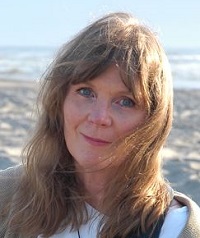 Ann Gates Fiser[/caption]