Many would consider a four-chord-song to be a song with one completely unnecessary chord in it, and it is true that there are many brilliant three-chord-songs.
Country songwriter Harlan Howard famously stated that all he needed was “three chords and the truth” and my mother-in-law used to joke that she only knew how to play three chords and a thousand songs, and that I seemed to know thousands of chords but only three songs.
It would be fair to say that there are definitely a lot of ways, both simple and complex, to decorate our songs with harmony, and it is well worth our time to explore some options and detail some of the rules of the road when it comes to “chording up” our tunes.
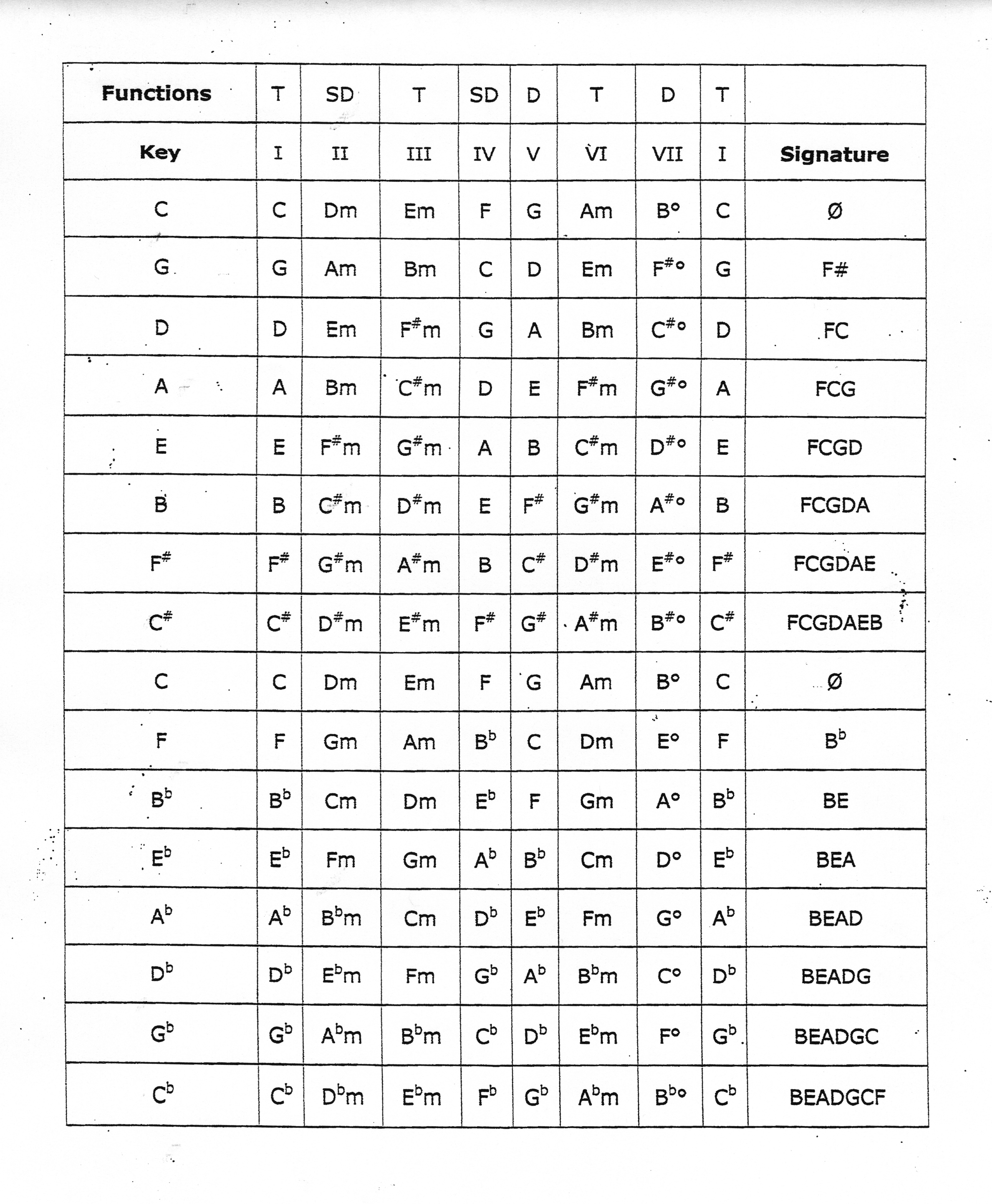
One of the first determinations, when looking for the greatest number of chord options for our song, is to establish what key that song is in. Determining key is easier with the help of the following chart which lists the names of the keys in the left column, lists the number of sharps and flats in the right column, and displays the chords indigenous to that key in the rows between. When attempting to establish which key a particular song is in, there are lots of criteria that music theorists factor into the equation, but in most cases we can simply state that “majority rules”. In other words, whatever key most of the chords are in, is a pretty good key to work within.
If we determine that all (or at least most) of our chords are in a given key, then we can add, remove, shift, or replace any of the chords in our song with other chords from that same key. Although we are not guaranteed to like the result of every choice, we might find some chords that fit to our liking and some of those good choices will provide a foundation to work from as we add chords to the other parts of the song.
As we continue to edit, we can then start to focus our chord selections by applying one of the many chord substitution techniques that are built right into the key system. A substitution technique that is fairly straightforward and easy to apply involves relative chords. The general concept of harmonic relation acknowledges that chords are considered similar to one another by having the most notes in common and therefore offer the greatest likelihood for success during substitution.
For instance, a C chord is a relative to Am due to the two notes they share in common (c, e) and therefore they can substitute for one another almost always and with very little, or perhaps even no adjustment to the melody. Likewise, a Dm chord is related to an F chord and an Em is related to a G, all within the key of C. Numerically, we can more broadly state that the I chord is related to the vi chord, the ii to the IV chord, and the iii to the V chord in every key, which gives us a substitution platform that we can apply to any key we choose to write in.
A terrific way to test drive this concept of relative harmonic substitution is to take a song you have already written in the key of C (or any other key using the chart above) and swap out the relative major and minor chords. You would then listen and assess the effect of each of the alterations. This may not necessarily increase the number of chords in our song but it will definitely get you more used to hearing your song framed in a new chord system that might challenge your initial choices as well as challenge the general feel of the song as well. Think of this as the training camp of chord substitution.
As far as using relative substitution to increase our chord count, a great technique is to use the relative major and minor in each section that previously featured only one of the two chords. For instance, in a bar where we had previously been playing just a C chord, we would now try a split bar of C to Am, then try Am to C, and determine if either of those options is more likable than the original chord choice.
I often teach the concept where we consider our songs initial chord progression to be an unchallenged ‘plan A’ until we have tried replacing the chords with at least three other progressions (plan B, plan C, plan D) to determine if there is a better progression available, at least with the options from this primary substitution concept of related majors and minors in splits and/or swaps. There are a few more ways to substitute harmony that are only slightly more complex than relative major/minor substitution that offer even more chord options. Let’s save those for another time.
In the end, the goal of this exercise is to ‘rule in’ or ‘rule out’ that the best progression for our song is the 4-chord box pattern that we often initially use to bring our songs into existence.
Have you ever played an open mic and you couldn’t hear your vocals? Or maybe they were drowned out by your guitar?
Have you ever tried getting a little more volume out of your guitar but it wouldn’t stop feeding back? Or maybe the guitar sounded good, but the vocal mic was feeding back in the monitors?
Have you played an open mic where your guitar sounded fuzzy and distorted even though you wanted it to be crisp and clean? Or your vocals were really boomy or harsh?
Have you been listening to a songwriter presenting their latest masterpiece but were unable to understand the words? Or the vocals were so loud to be heard over the guitar that the whole sound was mucky and harsh?
As a performer or a host, knowing how to run a basic PA system is invaluable toward getting the best performance and the best response from the audience. Imagine if you were listening to the radio but it was really quiet and distorted. How would you know if you liked the song that was playing if you couldn’t really hear it clearly?
I’ve played many open mics where the host had very little knowledge about running sound and as a result the music was imbalanced, distorted, glitchy, obnoxious, or worse. I rarely return to an open mic with poor sound, so if you are one of those people running a show, and you are trying to build a faithful following, then knowing how to produce good sound should be very important to you. It has been my experience that many seasoned professionals think that they know how to run sound, but have been doing it poorly for many years.
If you have no formal training in sound, then it is likely that you are making mistakes that adversely affect the quality of your sound. How drastic these mistakes are can affect the sound slightly or very much. A basic understanding of the fundamentals of running live sound, which you can learn in an afternoon, can make a HUGE difference in the overall quality of your presentation. The great news is that you do not need a degree in sound engineering to run PA for live applications. A few simple concepts can make a profound difference.
Also, as a performer, understanding the basics of running sound can help you to provide a quality signal to the person who is running sound, and make it much easier for them to create an excellent mix. You’ve spent years learning to play your instrument, learning to use your voice effectively, learning to write excellent lyrics and melodies over compelling chord progressions. Doesn’t it seem worthwhile to learn how to present all these skills in a more attractive way?
There are a few basic concepts that radically influence the quality of the sound that comes out of the speakers. Here are a few of the most important:
GAIN MANAGEMENT
The most important idea is that you want a strong (but not too strong) signal at each step of the chain, from the mic or instrument, through the mixing board and into the amplifier, and finally out of the speakers. The technical term for the strength of the signal is ‘gain’. Properly managing the gain of your signal prevents distortion, feedback, hum and hiss, and other artifacts that make your sound less than optimal. Managing gain is a fairly simple process if you understand the signal chain and the steps involved but is the most common mistake that seasoned professionals make through simple ignorance. Don’t be that person, learn to manage the gain through your signal chain.
EQUALIZATION
Another common mistake is poor equalization of the signal. Poor EQ can cause voices to be boomy, harsh, or weak, and cause guitars to feedback, distort, or sound thin. Simple EQ concepts can also heighten the separation between voices and instruments and help them both be heard more clearly at lower volumes. Learn a little about this process and some simple steps to achieve more pleasing sounds.
MONITORS
Another simple concept that can help everybody sound better and feel better about their performance is knowing how to set monitors. The general idea here is that you should only provide the performer with the sound that they need, which is often mostly vocals. You cannot sing accurately if you cannot hear yourself. Including the guitar or keys may be less important because it is likely that the performer can hear their instrument directly. That’s not to say that you should provide only vocals, but providing more vocals than instruments is one way of getting the performer(s) the needed sound support while avoiding feedback. At the same time, the performer needs to be able to hear the instruments well enough to sing in tune with them, so getting a reasonable balance is important. Fortunately, a little knowledge and practice can make a significant improvement.
A few other important concepts are:
Prevent pops and bangs when turning equipment on and off
Avoid clicks and pops when plugging and unplugging instruments and mics
Treat microphones properly to avoid damage, feedback, ‘proximity effect’ and other unwanted artifacts
Place speakers for maximum effectiveness
If you THINK you know how to run sound but have had any of these problems and didn’t know how to solve them, then you should probably take a few hours and learn to run a PA system. It’s not very difficult if you understand the basic concepts. Without that knowledge it is difficult to avoid common mistakes. Don’t be that person; your audience will be happier, your performers will be happier, and you will be happier.
Ask a songwriter when their writing journey began and you will usually find memories tied to a certain age or a certain musical experience. But for Pacific Northwest singer-songwriter Val D’Alessio, the writing muse is inextricably woven into a specific place – one whose unromantic nickname belies its effect on her songwriting career: a group of cabins affectionately known as ‘the Lumpy Dumps’.
“I remember exactly how I started writing songs. I had been playing and performing music since the age of 10 but I had never been able to write my own songs until I reached the ripe old age of 33. I was living in a group of cabins affectionately known as ‘the Lumpy Dumps’ in Bellingham, where a lot of creative crazies lived. It was the perfect setting for me to discover the joys and success of songwriting for the first time. I sat down with my guitar and started noodling and didn’t stop until I came up with something! Low and behold, I was visited by the muse right there in Lumpy Dump #11, where I wrote all the songs on my first CD, in a relatively short period of time.”
Val recalled that she, “felt like the Grandma Moses of songwriters at that time because I was around a lot of musicians who were quite a bit younger than me, and they were already boldly writing and performing their own songs. I was determined to write some songs, and I wasn’t going to let my inner critic prevent me from moving forward with that intention anymore.”
Though she started writing later than some, Val’s passion for music began in childhood. After an early start where she “taught herself to play Beatle songs at age 10, sitting in her room in Winthrop, Maine,” Val moved on with her brother to form a classic-rock band and then to acoustic music when the band broke up. After this time, she explored the guitar stylings of James Taylor, Mississippi John Hurt, and other blues artists, as well as the tunings of Joni Mitchell.
Val, according to her bio, “moved across the country, covering songs in various music configurations including solos, duos, and bluegrass bands, finally playing lead guitar and singing harmony vocals for Bellingham, Washington-based acoustic-pop band ‘Men Without Pants’. She loved the band’s name and their catchy songwriting. However, she still found herself playing the same support role as she had in most of the bands she had been in before. She passionately wanted to develop her own musical voice and songwriting. And it was at the Lumpy Dumps that her passions became a reality.
Val admitted that her writing process now differs from her early process in Bellingham. “Probably like most writers, my process varies. Typically, I noodle around on the guitar waiting for a riff and chord progression to find me. This immediately gives me the feeling or mood of the song. I then start singing a melody over the chords and let dummy lyrics, or a stream-of-consciousness with words flow, until I find out what the song is about. Once I get a sense of what the song is about and get on a creative flow with lyrics, everything else seems to fall into place for me.”
Though this is her “typical songwriting process”, she also explores other avenues for coming up with a song. “I enjoy having a song topic or title come to me in the form of a complete idea. For example, my song ‘I Hope I Screw This Up’ was a title I saw and lifted from a T-shirt someone was wearing. Less often a melody comes to me first in either a complete form or in pieces. I love it when that happens. I love a great melody! It brings me into a song and great lyrics keep me there.”
Oftentimes, writers comment that their ‘zone moments’ come when they are least conscious of a process. Val herself commented that, “The best ever is when a song comes more through me than to me. It comes almost in complete form with melody and lyrics. This doesn’t happen very often but when it does I am always very pleased with the song.”
A career as a performing singer-songwriter, while rewarding, is also fraught with challenges. For Val, “My greatest challenge as a writer is to relax and allow creative flow to happen without pushing or struggling. It is a challenge of focus and intention, in which I allow the muse in without letting the distraction of negativity prevent the creative process.
“My challenges as a performing songwriter are similar: It is to relax and go with the organic flow of the evening. I want to allow myself to ‘screw up’ and recover without losing my focus or allowing negativity to distract me from my intention of connecting with an audience. My desire is to be fully present with the music and let it flow with the intention of connecting with those who are receptive to my music. I want to stay in an attitude of gratitude of appreciation for my audience and the opportunity to perform, without being distracted or derailed by negative thoughts. I like to imagine that I am in my living room, after I have just finished writing a song, as I am performing for an audience. I love that feeling of being on fire with a creation, when the self-doubt goes away and I am most present and connected to the music.”
As a musician trying to make a living, the struggles are not tied to the externals of money but rather to internal dialogues. Val explained, “The greatest challenge… is to value and honor my dream of making an abundant living as a singer-songwriter without allowing the mind-clouds of negativity to distract me, mainly self-doubt. The challenge is to be happy with where I am as a performing songwriter and excited about where I am going at the same time. When I am able to hold that focus, everything about making a life as a musician seems to fall into place.”
In the songwriting journey, writers often seek inspiration from the world around them, and for Val D’Alessio, that inspiration comes from community, which she says is, “an absolute source of inspiration for me as a creative person. I adore the SiS organization and all the people who contribute their time and talent in this community.”
Another part of her community that inspires Val is children. “Children are such natural ‘allowers’ and generators of creativity. They naturally understand the value of their creations and can offer them freely to others. The ‘young songwriters’ in my life, children who have come to me through my music teaching practice, have been my greatest teachers. They often model how to allow creativity to flow in a much easier way than adults. They are my teachers by example, and they hold a wavelength of purity and love like animals do. In fact,” she added, “I think of my cat, ‘Little Cat Stevens’, as my spiritual advisor.”
Because Val is inspired by the spontaneity of children, she advises adults who want to write to do what children instinctually know how to do: “Relax and allow yourself to feel the joy of the journey with songwriting. Know that your creative expression matters and you have something to express in a way that only you can. At the same time, let yourself be light with the process. If you set out to write songs because it’s fun, you can take the pressure off yourself and allow creativity to flow. You don’t need to worry about writing a ‘great’ song or even a ‘good’ song when you’re starting; just get it out. You just have to remember how you would do it when you were a kid.”
For adults, she also cautioned, “Don’t engage with those nasty, negative, critical voices that say, ‘this song sucks’ as you’re writing it, or even after you’ve written it. Love yourself and get over yourself at the same time. You don’t need to carry the burden of profundity with your lyrics or try to be dazzlingly original with your melodies. If you allow yourself to be who you naturally are in your creative expression, you can’t help but be original.”
She went on to explain, “I believe you learn to write songs by writing songs. You will discover how to edit and craft your songs as you go along. Trust that your songwriting process will develop over time but that the main thing is to get in there and mingle with the muse. Find out what you have to say and have fun with the creative process. That’s where the magic begins in songwriting.”
Once the song is finished, then the ‘how-to’ of performing becomes a next-logical-step. In Val’s own journey, “When I first started writing music, I played at Victory Music open mics, sometimes three times a week, because I knew they were a very supportive, inclusive songwriting community. I also had the advantage of performing my songs for some very developed performing songwriters who were my friends when I first came out as a songwriter. I knew they would give me insightful feedback and would be encouraging as well.”
For writers who are first testing the waters of performing, Val suggests what worked for her: “Play for people who you think will be supportive and encouraging of your growth as a songwriter… you have to get out there and play your songs for others in order to learn how to perform.” One question that looms for many is to puzzle out where the best places to play would be. Val advises, “First ask yourself WHY you would like to perform your music for others. I find that when I perform my music with the intention of connecting with others because it is fun and I believe I have something to offer and receive from them, I have much more fun, and I feel successful in the process. Feeling appreciation for my audience and the opportunity to perform frees me up to let my creativity flow in performance. It also allows me to be receptive to the gifts of my audiences, and there are so many! Performing is a very co-creative, organic process for me.”
Val utilized the resources of place and community to help her develop, but she credits her best career and life resource as, ‘the Source’, or what some people refer to as God or a Divine Presence.” She continues to rely on this source as she begins the next step in her career - one that also involves place and community. “I am in the process of connecting with a musical partner(s) with the intention of traveling around the US and eventually other countries, as we perform our music to receptive audiences, while making an abundant living from it. Right now I make the bulk of my living from my music teaching practice. I am excited to have it be the other way around at some point. I want to be traveling and touring frequently with my music and continuing to assist others with their creative expression in some capacity.”
Val D’Alessio is the living embodiment of one of her favorite Carlos Santana quotes: “If you stay in your heart you will always be inspired. If you are inspired, you will always be enthusiastic. There is nothing more contagious on this planet than enthusiasm. The songs become incidental. What the people receive is your joy!”
Val’s joy, this following of her heart, led her to a place where she could truly say she was centered in her calling. “Later on in life, when I began playing my songs out, I was more certain about the rightness of my decision to become a performing songwriter. It is an amazing feeling to feel like you have connected with people in a meaningful way with the songs you write.”
Though now fully immersed in songwriting, which she describes as both good and addictive, Val D’Alessio still gives a nod to that birthplace of her songwriting muse in Bellingham, Washington. “The belief that I was doing what I was ‘supposed’ to be doing by becoming a songwriter came gradually. I think I subconsciously knew it immediately in Lumpy Dump #11, where I first began to experience success at getting my music out of me.”
Chris Klimecky, Executive Director of Songwriters in Seattle, describes his own musical development as, “a long, slow evolution - even after 30 years, it is an inspiring and surprising process!”
Here’s his story in his own words:
Songwriting started for me when I was around 12 years old as a family collaboration activity where I grew up in northern Michigan: My older brother, Pete, wrote lyrics and I wrote the music. He also played bass and my cousin played drums while I did guitar and vocals in our band. During holidays when we could get together we’d set up a 4-track tape machine and record as much as we could - this went on through high school and the only shift in college was that we went into nicer studios. Once in a while I’d write a song all on my own, but for the great majority it was a collaboration, often with a keyboardist as well contributing on the musical side.
Even when that “team” finally dissolved in the late 90’s after releasing two albums, I had enough lyrics from my brother stashed away that upon first moving to Seattle, my first solo album, Marooned, consisted of similar collaborations - I simply considered myself to be a music writer, not a lyric writer. I took about five years off after that release to start a family and dig into my career as a videogame producer.
When I returned, I sought out new teammates for collaboration and discovered a nascent Songwriters in Seattle group. What I found there were people who opened my mind to new directions, new genres, and new ways of collaborating I never would have considered in my previous songwriting time. I also discovered I had learned over the years what makes good lyrics, and had something to say myself, which led not only to my editing those lyrics that were given to me to work with, but writing more and more myself. Over a three-year period I put together my most diverse group of songs in my catalog for my second solo record, Bankrupt Generation.
This period of exploration actually resulted in intense focus afterward. I had confidence and vision for what I wanted to do musically and was driven to put together a new set of songs and recordings that reflected that vision with high quality. While there have been fewer songwriting collaborations since, they still play an important part of my most recent album and my current work. As I now do it all for charity, my “why” for writing, recording, and performing has become more meaningful, emotional, and personal. I continue to find joy and fulfillment in songwriting and collaborating.
I was growing up in the music scene just as the industry/business side was falling apart due to the shift from people buying records/CDs to getting music cheap/free online. By the time I had something to offer there was no longer investment in young artists and artist development because there was no longer money to be made selling records. Though I spent many years in frustration over this situation, it resulted in experience that I could use to help others to perhaps have a better opportunity.
Having always been a part of music and arts organizations (both private and larger public orgs/schools), I began to see that there was a possibility that community could play some of the role of support system that record labels previously handled. As Songwriters in Seattle grew and developed, it became more and more apparent that we were onto something with that line of thinking. Songwriters have the tendency these days to hole up in their homes or apartments with their instruments and computers, and just “DIY.” I know, I did it myself for a number of years. What Songwriters in Seattle offers is unlike anything else I know of in the area for encouraging and supporting creativity, the creation of art, and the support of independent artists. I think it’s really important work and I am proud to play a part in making it function and helping it grow. Some unexpected benefits of taking on this role (as board president) are discovering what a huge, wide range of independent talent we have in the area. It feels almost infinite! With so many great surprises and great people I’ve met through the years, it has really been fun and inspiring. It has definitely motivated me to think about how we can be a force for elevating these talented artists and allowing them to do more of what they are capable of doing. It’s so hard, so time consuming, and so expensive to be an independent artist - they need all the support they can get in order to keep developing.
To help Songwriters in Seattle become even more effective, the two most important words for members are: SHOW UP! If everyone even picked one event per month to attend, we would have an elevated presence in the community. It would be more likely that each person could connect with someone who could help them personally. Share your knowledge, share your talent… this is not a competition. There is no one golden trophy to fight for - everyone’s on their own journey and we all do better when we help each other out.
Logistically, if someone wanted to be more involved, we can always use more volunteers to host events, manage our online presence (which helps foster participation), contribute to the newsletter, coordinate instructors, festival communication, etc. There is far more to do than myself and the current board members can handle.
Songwriters in Seattle is still a young organization (nine years total, six as a 501(c)3 non-profit), so there is still a lot to do in order to reach the potential of the impact we can have. One aspect of our long term vision is for us to have our own central location (in addition to events around the city, of course). There are multiple purposes for this - teaching space, collaboration space, recording space, “artist hangout” space, performance space… a true multi-purpose community location that represents and supports the needs of the organization and the artists we work to elevate.
Whether you’re a hobbyist or professional (or seeking to be professional) artist looking to develop your full potential as a songwriter, we at Songwriters in Seattle believe we are creating the stepping stones to help inspire, motivate, and elevate you to a more fulfilling musical life. If you think that’s as important as I do, we could use your help in continuing to move toward that vision. We simply need volunteers who share this vision and would be willing to put the time in. Thank you!
We don’t often talk about this in Songwriters in Seattle but let me remind you… songwriting is an art form, and you are an artist. This is an essential truth about songwriting.
So I would recommend that you don’t be too hung up on writing your songs “correctly”. In much the same way as a visual artist can play with shape and form and structure so can you! Remember that your art form is to form a connection or to convey a message to your audience. The beauty of music is that you can convey a deep emotional meaning in your songs.
I have personally found songwriting my most satisfying form of expression. When people ask me how I write a song I often refer to a song like a sculpture. The song in its infancy has an inherent form and shape. The artist hears it and appreciates it for its beauty. That form is then worked on, smoothed and perfected into a final form which is often more complex and more beautiful than its original form. However, you can overwork a song so beware! As an artist it’s your responsibility to bring your song forward in its most gorgeous form.
When you’re done you can present it to the world in its entirety much like hanging a masterpiece in a gallery. But your masterpiece! In our SIS showcase gallery…
I have been very fortunate to be able to witness all the varied talents that SIS brings forth. It always amazes me how many talented people we have in our midst with many more artists yet to come forth. Don’t try to copy others. Your voice is unique and appreciated.